


Now the rest of the story
- chateauaeronautiqu

- 2 days ago
- 4 min read
If you have not read "An interesting experience from a pilot
" please go back and read that blog before this one!
My first flight trip on the DC-8 was a day trip through South America. I was a brand-new Flight Engineer operating under the watchful eye of a 75-year-old Flight Engineer instructor.
The first leg, from Miami to Lima, Peru, was an exhilarating five-hour flight over Cuba, the Caribbean Sea, and the mountainous jungles of Colombia, Ecuador, and Peru. I still remember the moment we crossed the Equator—my first time.
After a few hours in a hotel, we departed into the night for Iquitos, Peru, one of the most isolated cities in the world, 500 miles deep in the Amazon jungle. There were no roads to Iquitos—you arrived by boat or airplane.
As we descended through a 10,000-foot overcast, the glow of Iquitos' lights emerged 30 miles ahead in the pitch-black void that stretched indefinitely in all directions. Knowing the vast darkness below was dense, deadly jungle was unnerving.
The copilot was flying. I remember the Captain telling him that the runway was short and made of shale, not concrete, and that the misty conditions would make it slippery.
"Get it on, and get it stopped."
The copilot replied confidently:
"Yeah, I got this."
In his zeal to make a good landing, he floated the airplane down the runway... and floated... and floated....
Finally, in a raised voice, the Captain barked:
"Get it on!"
At touchdown, all four engines roared into reverse thrust — without much effect. Early reversers didn't do much to stop airplanes.
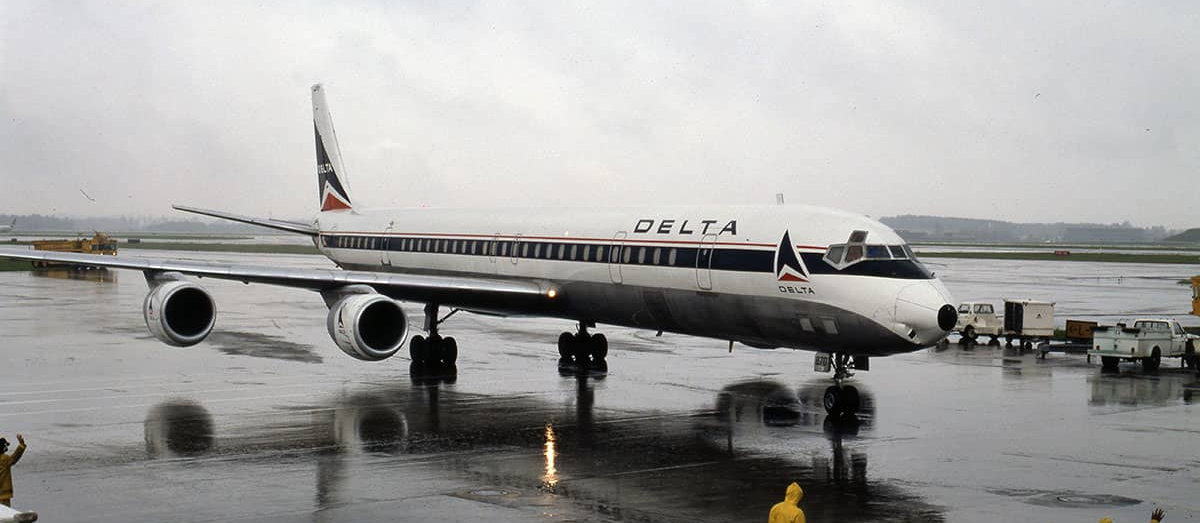
A little background: the DC-8 was Douglas Aircraft's first jet-powered airliner. Compared to the propeller-driven DC-7, cruise speed increased by roughly 240 mph and landing speed by about 30 mph. The DC-8 also weighed more than twice as much as a DC-7.
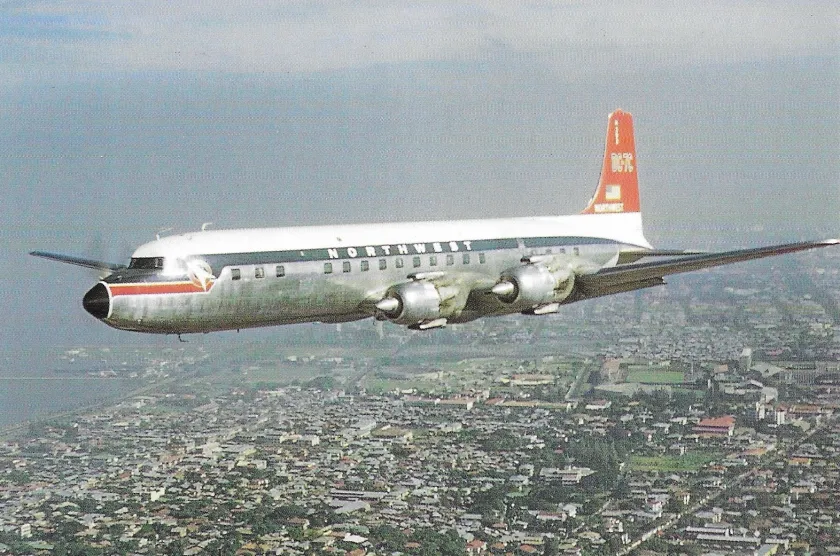
The problem was that braking technology hadn't advanced nearly as fast as airplane performance. To this day, crews are practically guaranteed to blow tires if they touch the brakes above 100 knots.
Each main landing gear tire contains fuse plugs designed to melt and release air if the wheel overheats. If a fuse plug fails to do its job, the tire can explode. Since jet tires were steel-belted radials, they can throw shrapnel with tremendous force. Crews are taught to approach hot tires only from the front or rear—never from the side.
Back to the matter at hand.
As the end of the runway loomed closer, somebody jumped on the brakes prematurely.
My instructor immediately started yelling:
"Off the brakes! Off the brakes!"
He had no desire to spend the next several hours changing tires in the middle of the night in the Amazon.
We finally came to a stop with the nosewheel off the end of the runway, in the grass.
After everyone drew a collective sigh of relief, the Captain put all four engines into reverse and backed the airplane onto the runway.
Reversing a DC-8 was prohibited by the operating manual.
What happens in South America, stays in South America.
We parked on the ramp and shut down. As I descended the airstairs, I could see smoke billowing from the main landing gear trucks beneath the wings. The spectacle attracted a crowd of curious locals, whom I quickly shooed back to a safer distance.
Then we crossed our fingers and hoped the fuse plugs would hold.
The cargo was unloaded, the cargo door secured, but we couldn't depart until the brakes cooled.
While we waited, the copilot and I took a stroll toward the end of the runway we had overshot.
It was then that we could see the carcasses of several airliners in the jungle off the end of the runway that had failed to stop.
That was a surreal moment.
As we walked back toward our airplane, I noticed a dense fog bank rolling in from the jungle only a few feet beyond the runway edge.
Suddenly everyone was panicky.
"We gotta go! We gotta go now!"
Once the fog arrived, the airport would close and we'd be spending the night in Iquitos.
As I scrambled up the airstairs, I glanced back and saw the landing gear still smoking.
The Captain and copilot started the inboard engines. While taxiing, my instructor and I started the outboard engines—a procedure I had never practiced in the simulator.
We were winging it.
We rounded the corner and blasted off.
By the time the Captain pulled on the stick to rotate for lift off, we were in the soup.
After a few minutes of flight, just long enough to gain a safe altitude, the Captain called:
"Gear down."
The copilot lowered the landing gear to cool the wheels in the slipstream.
We flew that way for about twenty minutes.
Finally, the gear was retracted and we continued our journey into the night toward Bogotá, Colombia, where we would do it all over again.


Comments